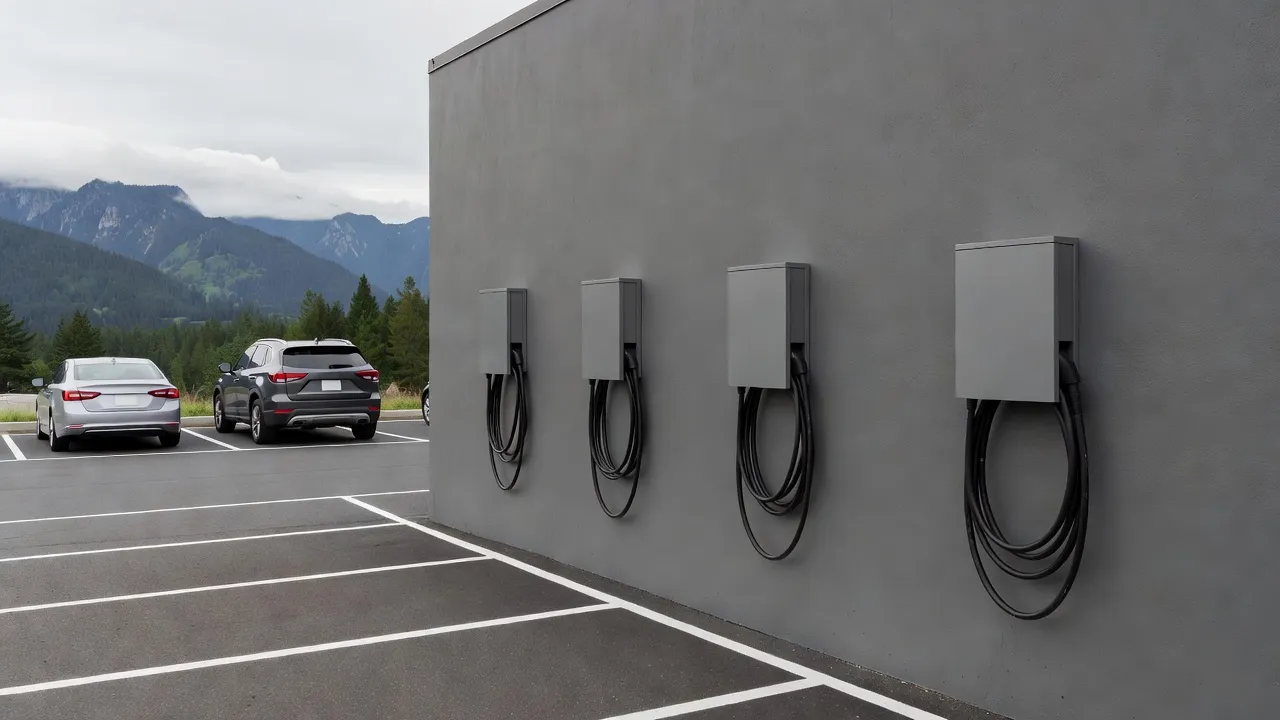
Four wall-mounted Level 2 EV chargers on a commercial building beside a parking lot, Fraser Valley mountains behind

For workplaces, stratas and rental buildings

Commercial EV Charger Installation in the Fraser Valley

Commercial EV charger installation for your staff, tenants, residents or customers, sized to the power your building really has. Licensed local electricians check your capacity, give you a plan and a real quote, then handle the permit, install and inspection.

We start by finding out how many chargers your building can actually power, before you buy anything.

  • Licensed and insured
  • Permit and inspection through Technical Safety BC
  • 5.0 from 32 Google reviews

Who it's for

Built for Workplaces, Stratas and Rental Buildings

A commercial EV charger plan starts with one question: who parks here, and for how long? Find your building below. The chargers are often the same. The plan around them isn't.

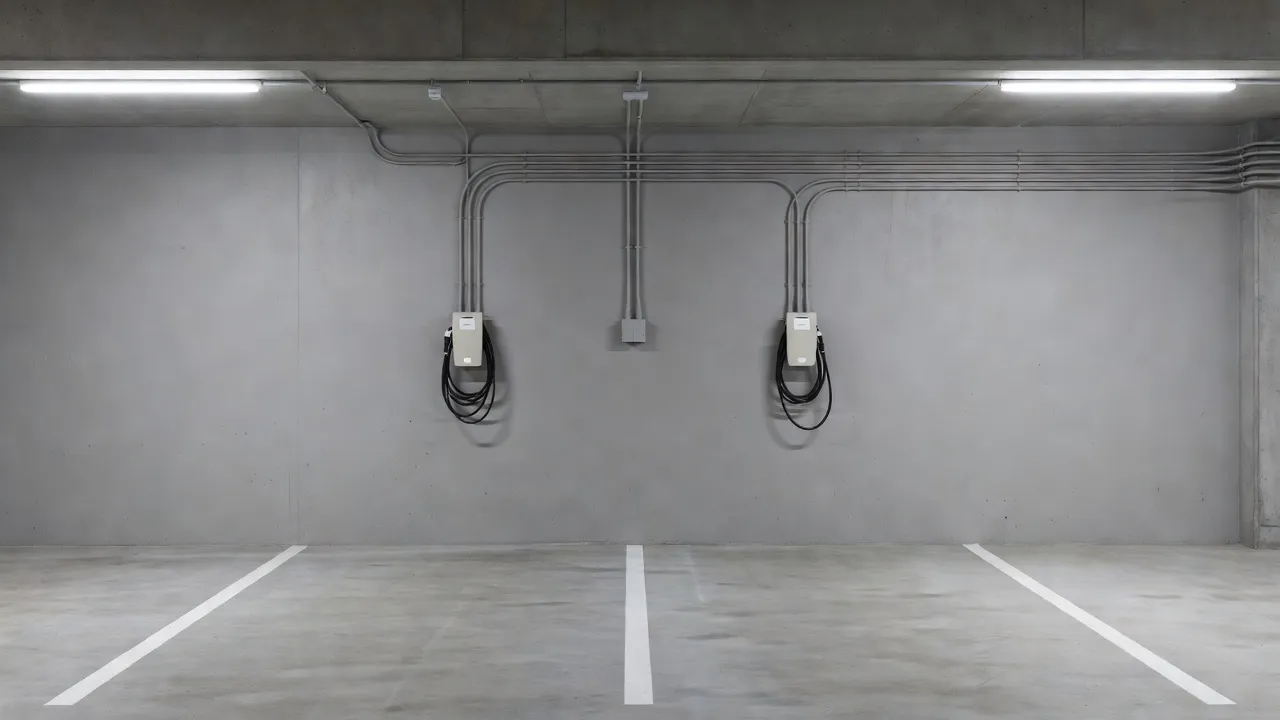
Two Level 2 EV chargers on an apartment parkade wall, fed by neat conduit runs along the concrete
What shared-parkade charging really looks like: conduit along the ceiling, dropped to a charger at each stall.
  • Parked all day

    Workplaces

    Your staff park for a full shift, so a few Level 2 chargers that share power can fill every car before they head home. With at least five employees on site and chargers set aside for them, your business may qualify for the workplace charger rebate.

  • Parked overnight

    Stratas and Condos

    Residents charge overnight in a shared parkade, on common property, so council needs a plan the owners can vote on. Most EV charging decisions now pass with a majority vote, and the plan starts from what your Electrical Planning Report found.

  • Tenants and customers

    Landlords and Retail

    Someone else plugs in, and you want to know who pays for the power. Networked chargers record each session, so the electricity can be billed to the driver or the tenant instead of quietly landing on your account.

Charging at your own house instead? That's a simpler job with its own page: home EV charger installation. Need more than chargers? See our commercial electrical work.

Power first

The Real Question Is How Much Power You Have

The fear is a new transformer before the first car plugs in. Many buildings can start on the power they already have, and a capacity check tells you whether yours can. That's where every commercial EV charger installation should begin.

Your spare power Never changes
  1. Stall 1 50% speed
  2. Stall 2 50% speed
  3. Stall 3 50% speed
  4. Stall 4 50% speed
  5. Stall 5 Empty
  6. Stall 6 Empty
4 cars charging on the same supply. Each charges at 50% speed, and cars parked for hours still fill up.

Illustration only: a supply with room for two chargers at full speed. Your capacity check gives your building's real numbers.

  1. 01Measure first

    Check the Capacity Before You Buy

    We look at your service, your panel and how much power the building actually uses, then tell you how much is spare. That sets how many chargers you can run, before anyone spends a dollar on equipment.

  2. 02Share the supply

    Let the Chargers Take Turns

    Power-sharing chargers split a fixed supply between whoever is plugged in. When more cars arrive, each one charges a little slower, and cars parked for a shift or overnight still fill up. Most networked commercial Level 2 chargers can do this.

  3. 03Know early

    If You Do Need More Power, You Hear It First

    Some buildings really do need a bigger service. The capacity check tells you up front, so that cost goes into the plan instead of turning up halfway through the job.

Panel itself needs work? That's a common, smaller fix: electrical panel upgrades. Want to know what your building can carry? Get a free quote or call (604) 754-4344.

Choose the charger

Level 2 or Fast Charging: Match It to How Long Cars Park

Charging speed only matters if a car leaves before it's full. Your staff park for a shift and your residents park overnight. That's hours, and Level 2 is built for hours. Fast charging is a far bigger project, and most workplaces and stratas honestly don't need it.

How long cars park, and the charger that fits
  1. Under an hour Highway stops Fast charging
  2. A few hours Visitors and customers Level 2
  3. A workday Staff Level 2
  4. Overnight Residents and tenants Level 2

What we install

Level 2 Chargers

Cars top up slowly and steadily while they're parked anyway.

Suits
Workplaces, strata parkades and rental buildings, anywhere cars sit for hours.
Power
Runs on 208 or 240 volts, the kind of supply your building already has. Power-sharing models split it between stalls.
Rebates
The CleanBC workplace and apartment charger rebates are for Level 2 chargers.
A different kind of project

Fast Charging

Built for a quick stop, not a parking lot where cars stay for hours.

Suits
Highway stops and places where drivers need a big charge during a short visit.
Power
Needs far more power than Level 2, which usually means a bigger service planned with BC Hydro or FortisBC.
Our part
Our commercial work is Level 2. If your site really needs fast charging, we'll tell you straight.

Not sure which fits your lot? Tell us how long cars actually sit there and we'll size the plan around it. Get a free quote or call (604) 754-4344.

Five steps, start to finish

How a Commercial EV Charger Installation Actually Works

Every commercial EV charging station installation we quote follows the same order. You know what happens next, what it means for your parking and what you'll have in hand at each step.

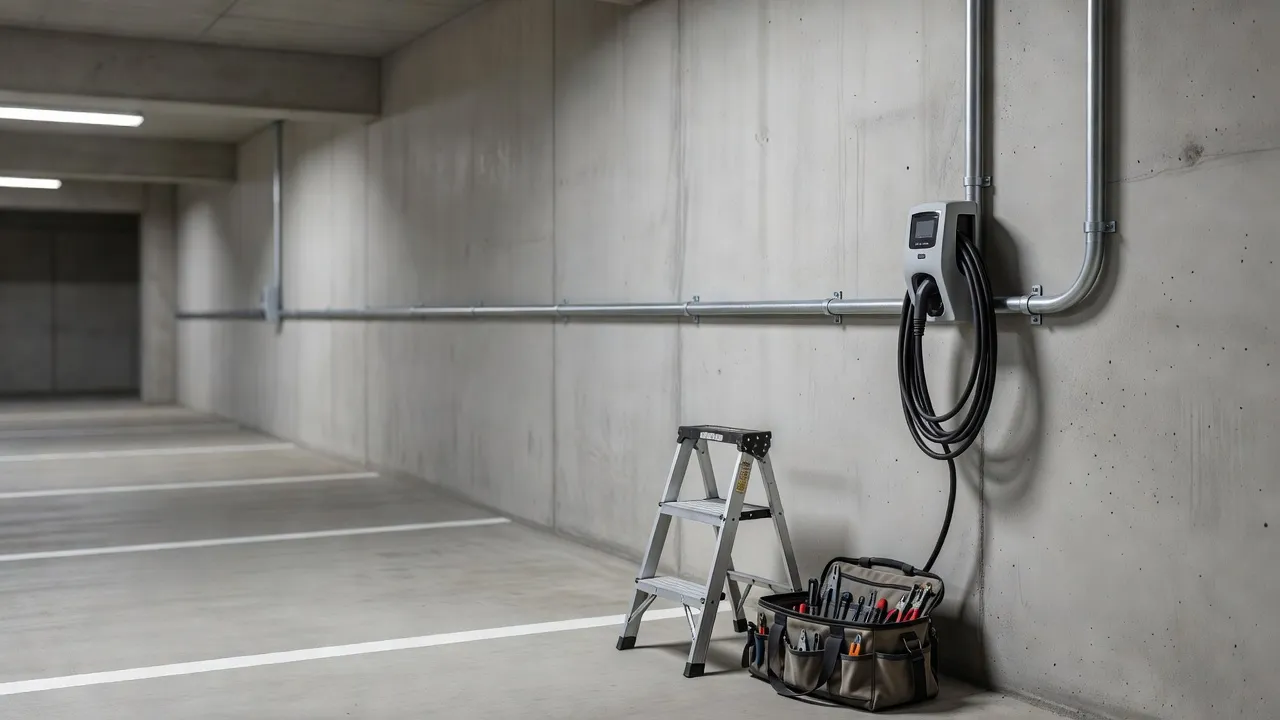
Conduit strapped along a concrete parkade wall to a wall-mounted EV charger, with a step ladder and an electrician's tool bag below
Conduit strapped tight to the concrete, run straight to the charger.

Step one is free.

The site visit and quote cost nothing and come with no obligation. You'll know what your building can power before you spend a dollar.

  1. Site Visit and Capacity Check

    We walk your lot or parkade, open the electrical room and look at the service, the panels and how much power the building actually uses. That load calculation tells you how many chargers it can run before anyone buys a thing.

    You getA straight answer on how much power you have to work with.

  2. A Plan and a Written Quote

    We lay out which stalls get chargers, how they share the power and where the conduit runs. Then you get a written, itemised quote. If your strata has an Electrical Planning Report, the plan starts from what it found.

    You getReal numbers to take to your owner, budget or council meeting.

  3. Rebate Pre-Approval, Then the Permit

    Order matters here. The CleanBC rebate needs pre-approval from BC Hydro or FortisBC before chargers are bought or installed. We give you the itemised quote and documents the program asks for, then pull the electrical permit with Technical Safety BC.

    You getNothing bought too early, so the rebate isn't lost on a technicality.

  4. Install Around Your Hours and Parking

    Before we start, we agree which days we're on site and which stalls close while we work. If the power has to go off briefly to connect the new circuits, you pick the time with us and everyone gets told ahead.

    You getStaff, tenants and residents still have somewhere to park.

  5. Inspection and Hand-Over

    The work is inspected under the permit. Then we switch the chargers on, connect them to their network and show you how access and any charging fees are set up.

    You getWorking chargers, and the invoice and permit paperwork the final rebate claim asks for.

Rebates · as of November 2026

Rebates: Get Pre-Approved Before You Buy

BC's CleanBC Go Electric program pays back part of a commercial EV charger installation at workplaces and apartment, condo and townhome buildings. The catch is the order. You need pre-approval from BC Hydro or FortisBC before you buy or install anything, and costs from before that approval aren't eligible.

What if the chargers get bought first?

  1. BDT Electric

    Capacity Check and Quote

    We check how much power your building has and give you an itemised written quote to apply with.

  2. You

    Apply for Pre-Approval

    Send the application and quote to BC Hydro or FortisBC. BC Hydro replies within 30 days. Nothing gets bought yet.

    Too late to count

  3. BDT Electric

    Buy and Install

    Networked Level 2 chargers, installed by a licensed electrician under a Technical Safety BC permit and inspected.

    Bought too early

  4. You

    Claim the Rebate

    Projects that only add chargers then have six months to finish and send in the final application with the invoices. EV Ready wiring projects get nine.

    Nothing left to claim

  5. The rebate

    Up to 50%

    of eligible costs back, paid after the final application.

Pre-approval came first, so the charger, the labour and the permit can all count toward the rebate.

Workplaces

50% back, up to $2,000 a charger

Up to $14,000 per workplace. You need at least five employees on site, with the chargers for staff during work hours, not customer or fleet parking.

Eligible costs include the charger, installation labour and conduit, the electrical capacity assessment, permits, design, signage and two years of network fees.

BC Hydro workplace charger rebates

Apartments, condos and townhomes

50% back, up to $2,000 a charger

Half the cost of each charger, up to $2,000, or $4,000 for a charger with two plugs. Up to $14,000 a year per building. It's for buildings with five or more homes that people live in full time, not short-term rentals.

The building needs a power study on file first, showing how much charging its electrical system can carry. A strata's Electrical Planning Report counts. Buildings wiring every parking space for future chargers can get more, and the program page has the full rules.

BC Hydro apartment and condo rebates Go Electric BC multi-unit charging

Every rebate charger has to be

  • Level 2, 208 or 240 volt, with the standard plug most EVs use (J1772) or the Tesla-style NACS plug
  • Connected to a charging network, with at least two years of service
  • New, bought (not leased) from a Canadian supplier and certified for Canada
  • A new install or an expansion, not a replacement
  • Installed by a licensed electrician
  • In a building built on or before August 31, 2022

Tesla products and taxes aren't eligible.

We plan the job so it can qualify, and give you the itemised quote and the documents the program asks for in the right order. You apply, and the utility decides. Workplaces and multi-unit buildings can also get up to five free hours with a program EV advisor. Get a free quote to apply with

For strata councils

For Strata Councils: What the Rules Now Allow

If your council has stalled on chargers because you'd never get three-quarters of owners to agree, that hurdle is gone. BC's Strata Property Act changed in December 2023, and three things in it are worth knowing before your next meeting.

  1. Majority

    Used to be ¾

    A Majority Vote Now Approves EV Charging

    Since December 6, 2023, a simple majority at a general meeting can approve EV charging on common property. That covers spending from the contingency reserve fund on charging and on managing its electricity, changing common property to add chargers, buying the charging equipment, and paying for a report like an Electrical Planning Report.

    A special levy, including one for EV charging, still needs a ¾ vote.

  2. Fraser Valley and Metro Vancouver

    Your Electrical Planning Report Is Due

    Stratas with five or more lots in the Fraser Valley Regional District or Metro Vancouver need an Electrical Planning Report by December 31, 2026. That covers our whole service area, Surrey to Hope. The report sets out your building's current capacity, its peak demand and spare capacity, and what future loads like EV charging and heat pumps would need.

    It's the honest starting point for chargers. Once you have it, we can work from what it found and plan chargers within the power your building already has.

  3. 3 months

    For council to decide

    Owners Can Ask for a Charger at Their Own Cost

    Once your strata has its report, or the deadline passes, an owner's properly made request to install EV charging can't be unreasonably refused. A real lack of electrical capacity can be a reason. Council has three months to decide, and the strata can ask the owner to pay the costs and agree to reasonable conditions, like an approved contractor and materials.

    The request needs a qualified contractor's description of the work with a cost and time estimate. That's what our written quote gives an owner to take to council.

Who pays for the power? A strata can charge EV users a reasonable fee, including a rate based on the electricity they use, once it's set in a bylaw or rule ratified by majority vote.

From the Province's pages on EV charging in stratas and the Electrical Planning Report, checked November 2026. A plain summary, not legal advice.

Have your report, or an owner asking? Get a free quote and we'll show your council how many chargers the building can actually power, or call (604) 754-4344.

Cost

What Shapes the Price

You'd like a number before going any further, and that's fair. We don't publish one, because the price of a commercial EV charger installation depends more on your building than on the chargers. These six things move it most, and you can usually tell which way yours lean before anyone visits.

  • How Many Chargers

    More chargers cost more in total, but the planning, permit and main wiring are shared, so each added charger usually costs less than the first.

    Costs less when
    You put in several at once, or run conduit for future stalls while the work is open.
    Costs more when
    You add one now and another next year, paying for the setup twice.
  • Distance From the Electrical Room

    Every metre between your panel and the parking stalls is wire, conduit and labour.

    Costs less when
    The stalls sit close to the electrical room.
    Costs more when
    The parking is at the far end of the lot or down a level or two in the parkade.
  • Parkade Wall or Trenching Through Asphalt

    Conduit strapped along a concrete wall is straightforward. A surface lot can mean cutting and trenching to reach the stalls, then patching the paving.

    Costs less when
    Chargers mount on a parkade wall, a column or the side of the building.
    Costs more when
    Chargers stand on pedestals out in an open lot.
  • Spare Electrical Capacity

    Often the biggest one. If your service has room, the chargers connect to the power you already have.

    Costs less when
    The capacity check finds spare power, or power-sharing chargers fit inside it.
    Costs more when
    The panel or the service needs an upgrade first.
    About panel upgrades
  • The Chargers and Their Network

    Networked chargers carry a yearly network fee. The network is also what lets chargers share power and track who used how much.

    Costs less when
    Chargers are matched to how long cars actually park, on a network the rebate accepts.
    Costs more when
    You pay for features you won’t use, or pick a charger the rebate doesn’t cover.
  • Permits and Inspection

    Every install needs an electrical permit through Technical Safety BC and an inspection. We pull the permit, and it’s in the quote from the start.

    Costs less when
    The work stays within the existing service.
    Costs more when
    The job grows to include a panel or service upgrade, with its own permit work.

Some of it can come back. If the chargers are for your staff, the workplace rebate's eligible costs include the capacity assessment, permits, installation and two years of network fees, as of November 2026. Get pre-approved before you buy. BC Hydro's workplace charger rebate

The honest way to a number is a site visit.

We walk your parking and your electrical room, check how much power you have to spare, and give you a written, itemised quote. It's free, with no obligation. And if you need fewer chargers than you thought, we'll tell you.

Questions

Questions From Owners and Councils

Once the power and the price make sense, these are the questions left. Straight answers, and if yours isn't here, ask us.

(604) 754-4344 or send us your question

Electricity and billing

Who pays for the electricity, and how do we bill it back?

You choose. Networked chargers record how much power each driver uses, and many charging networks can collect a fee from drivers for you, so the building isn't paying for someone else's commute. A business can also offer free charging to staff as a perk. A strata can charge users a reasonable fee, including a rate based on the electricity they use, once it's set in a bylaw or rule ratified by majority vote. We'll help you pick chargers whose network can bill the way you want before you buy.

Power during the work

Will we lose power while the chargers go in?

Only briefly, and never by surprise. Mounting the chargers and running conduit happens with your power on. The final connection at your panel needs a planned shutoff, and we book it with you ahead of time, outside your busy hours if that's easier. In a parkade we can work a section at a time, so the rest of the stalls stay in use.

Chargers you already have

We already bought chargers. Can you install them?

Usually, yes. Send us the model and we'll check it's certified for use in Canada and suits your power and your parking. One honest note: the rebate doesn't cover costs from before pre-approval, so chargers bought before you were pre-approved probably won't qualify. If you haven't bought yet, get pre-approved first.

Timeline

How long does a commercial EV charger installation take?

It depends on your building, so we'll give you a realistic timeline with your quote rather than a guess now. The steps are a capacity check, a written quote, rebate pre-approval if you're applying, the permit, the install and the inspection. Pre-approval is often the longest wait: BC Hydro replies within 30 days, and charger-only projects then have six months to finish, as of November 2026.

Where we work

Which towns do you cover?

We're based in Chilliwack and work across the Fraser Valley, Surrey to Hope: Chilliwack, Abbotsford, Mission, Hope, Agassiz, Harrison Hot Springs, Aldergrove, Langley, Surrey, Maple Ridge and Coquitlam.

Charging at home

I only need a charger at my house. Is this the right page?

Not quite, but we do that too. Our home EV charger installation page covers a single charger in your garage or driveway, and if you're in Chilliwack, see EV charger installation in Chilliwack.

Free site visit

Plan Your Chargers With a Licensed Local Electrician

Every commercial EV charger installation we quote starts the same way. We come out, look at your parking and your electrical room, and tell you straight what your building can carry. It's free, with no obligation.

You leave with

  • How many chargers your building can actually power today
  • A plan for where they go, and room to add more later
  • A written, itemised quote you can take to your rebate application or council

Licensed and insured, based in Chilliwack, working from Surrey to Hope. 5.0 from 32 Google reviews.

Two things worth knowing now

Before you buy anything

Rebates Need Pre-Approval First

Chargers bought or installed before your BC Hydro or FortisBC pre-approval aren't eligible, and BC Hydro says it replies within 30 days. Starting with the site visit keeps things in the right order. BC Hydro's workplace charger rebate

December 31, 2026

Strata Electrical Planning Reports Are Due

Stratas with five or more lots in the Fraser Valley Regional District or Metro Vancouver need one by December 31, 2026. Once yours is in, we can plan the chargers from what it found. The Province's page on the report

Call Now Get a Quote